Earlier this month, Anthropic quietly made one of the most consequential go-to-market moves in AI this year. No splashy product launch. No new model announcement.
Just a $100 million commitment to a structured partner program — the Claude Partner Network — and a clear signal about how they intend to win the enterprise.
As a partner marketer for a software platform where GSI relationships were crucial, this press release made me sit up. It signaled a company that was building an ecosystem and leaning into its market lead.
Here is why this matters, and what it tells us about where the enterprise AI race is actually headed.
The scoreboard: where Anthropic actually stands
Before we talk about the partner program, we need to talk about the scoreboard — because the shift has been dramatic.
According to Menlo Ventures‘ 2025 State of Generative AI in the Enterprise report, the era of automatic OpenAI wins is over. Look at the shift in enterprise LLM API market share over the last two years:
- Anthropic: Climbed from 12% to 40%
- OpenAI: Dropped from 50% to 27%
- Google: Climbed steadily to 21%
Enterprise AI investment tripled in a single year — from $11.5 billion to $37 billion in 2025. This isn’t a pilot market anymore. This is full-scale production. And in a production environment, Anthropic is leading.
The $100M partner program is Anthropic saying: We’re winning the product game. Now we are building the commercial infrastructure to make that lead permanent.
What Anthropic actually announced
The Claude Partner Network isn’t just a badge you put on a website. It’s operational infrastructure. The $100M funds:
- Direct capital: Subsidizing partner training, sales enablement, and co-marketing.
- Technical scaling: A fivefold expansion of Anthropic’s partner-facing team, bringing dedicated Applied AI engineers and architects into live customer deals.
- Formal credentials: Launching the Claude Certified Architect certification, with developer and seller tracks following close behind.
- Targeted IP: A “Code Modernization” starter kit designed specifically for legacy codebase migration.
Anchor partners: Accenture, Deloitte, Cognizant, and Infosys. Membership is free.
“We’re training 30,000 Accenture professionals on Claude because that’s what it takes to meet the demand we’re seeing.” — Alex Holt , Vice Chair, Global Head Anthropic Business Group, Accenture
You don’t pull 30,000 billable practitioners offline for training unless client demand is already pulling you forward. Cognizant went further — opening #Claude access to its entire workforce of roughly 350,000 associates. That’s an operational decision, not a press release commitment.
The contrast: OpenAI vs. Google vs. Anthropic
OpenAI‘s securing its enterprise footprint largely through bilateral deals. Their collaboration with Accenture on #ChatGPT Enterprise is real — but it’s a localized partnership, not a funded ecosystem program with certification infrastructure, shared playbooks, and a public directory. With usage share dropping from 50% to 27%, their recent executive hires signal they’re playing catch-up on GTM infrastructure.
Google leaned on its existing Google Cloud Partner Network when launching Gemini Enterprise, with Accenture, Deloitte, and TCS already involved. GCP gives them natural distribution. But they haven’t made a single, concentrated, net-new dollar commitment to building an AI-specific enablement layer the way Anthropic just did.
OpenAI has bilateral deals. Google has platform reach. Anthropic now has a structured ecosystem program with hard dollars behind it. That is a meaningful distinction.
The code modernization play — and why it’s brilliant
Buried in the launch is a Code Modernization starter kit. Anthropic calls this “one of the highest-demand enterprise workloads.” They’re right — but this isn’t just a product decision. It’s a deliberate wedge aimed at the most lucrative and most painful part of the GSI client portfolio.
Banks, insurers, and government agencies hold the most legacy COBOL in the world — and they’re the core client base for every #GSI on Anthropic’s partner list. Accenture reported $2.2 billion in advanced AI bookings in Q1 FY2026 alone, nearly double the prior year, with financial services among the primary sectors driving it. Legacy modernization is the defining transformation challenge for these clients right now.
A thoughtful IBM executive recently pushed back on this framing: if AI writes all the code anyway, why does the underlying language matter? COBOL skills aren’t the bottleneck if agents handle the coding. Mainframe migration is full system re-engineering, not just code translation. Fair point. Parts of it are correct.
But here’s the question that argument can’t fully answer:
Do you actually know which category your 40 million lines of COBOL fall into?
An acquaintance who spent his entire career working with COBOL for financial services since the ’70s put it this way: enterprises really run three kinds of code. First, the mission‑critical transaction systems you simply don’t touch, and for good reason. Then there’s the business logic written in COBOL because, well, it was 1987 and that’s what everyone used — all tightly coupled by accident. And finally, the integration and reporting layers that’s still on the mainframe mostly because it’s always been there, not because it makes architectural sense today.
And most enterprises can’t tell you which is which. That diagnostic is itself a high-value engagement. Anthropic’s starter kit gives a Deloitte or Infosys seller a structured entry point for a conversation that can grow into a multi-year, tens-of-millions-of-dollars modernization program. This isn’t about picking a fight with IBM. It’s about handing partners a wedge into the most stubborn — and most valuable — transformation problem in enterprise technology.
The $100M question: MDF, PDF, or SDF?
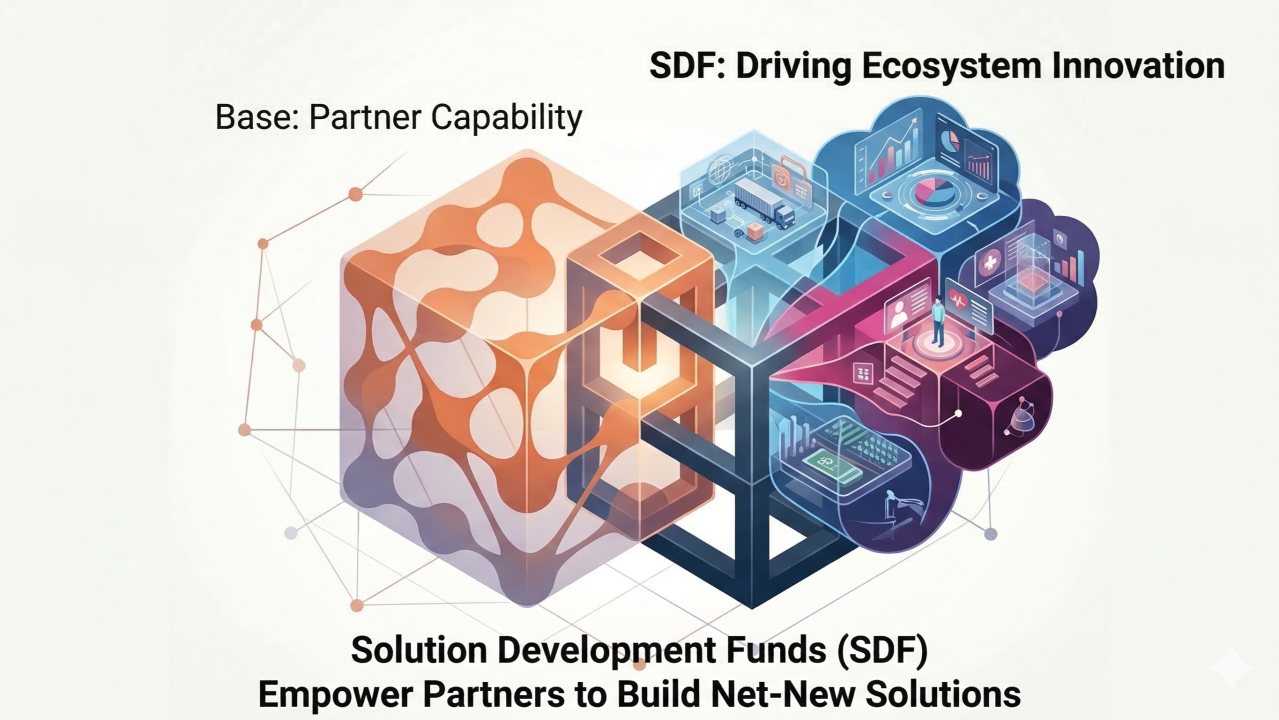
As a partner marketing professional, the part I’m intrigued by is how Anthropic will deploy this capital. Is this a traditional Market Development Fund (MDF), a Partner Development Fund (PDF), or a Solution Development Fund (SDF)?
The answer dictates what success looks like in 18 months.
- MDF optimizes for immediate pipeline (webinars, lead gen).
- PDF optimizes for partner capability (certifications, trained headcount).
- SDF optimizes for ecosystem innovation (partners building net-new industry solutions on your platform).
Given that Anthropic included shared sales playbooks, embedded engineering support, and specific IP starter kits, this looks like an SDF. It’s designed to accelerate deep capability-building, not just top-of-funnel marketing.
If that’s right, the benchmark for success isn’t how many co-branded events happen this quarter. It’s how many Claude-native solutions get built by GSI practices for highly regulated industries that Anthropic’s direct sales team could never penetrate on their own.
That’s the real bet. And looking at the scoreboard, it’s exactly the right one.
Next up: From MDF to SDF — how tech companies build partner ecosystems, why some fail, and what the Salesforce and AWS playbooks tell us about what Anthropic is actually trying to do here. It’s a rabbit hole I went down early in my partner marketing career, and right now it feels more relevant than ever. Worth a read if you’re trying to understand where sales, marketing, and alliances are heading.
Originally published on LinkedIn March 18th, 2026. Republished here with updates.