Author: Sameepa Shetty

  • Anthropic Spent $100M on Partners. Here’s the One Number That Will Tell Us If It Worked.

    April 2, 2026

    Article 4 of 4 · Anthropic Partner Series

    U.S. businesses spent roughly $40 billion on AI initiatives last year. According to a recent MIT initiative, 95% of those pilots delivered absolutely zero measurable ROI.

    The AI revolution won’t succeed until it escapes “Pilot Purgatory.”

    Being in the B2B SaaS trenches taught me that the most elegant enterprise software product in the world doesn’t matter if the partner ecosystem can’t figure out how to deploy it into a messy, legacy corporate infrastructure.

    And that’s the exact problem Anthropic’s new $100M Claude Partner Network is designed to solve.

    The launch came with big numbers: 30,000 Accenture consultants to be trained. 350,000 Cognizant associates granted access. Impressive recruitment stats — but ultimately, vanity metrics.

    The only metric that actually matters: How many of those partners can drag a Fortune 500 client out of Pilot Purgatory and close a production deployment within 90 days?

    That is the activation rate. And it is the only number that tells us if Anthropic is building a revenue-generating ecosystem, or just funding a $100M NASCAR slide!

    The Giants Already Wrote This Playbook

    A recruited partner signs an agreement. An activated partner does something much harder: they navigate enterprise procurement, survive the infosec review, and ship a solution into production.

    The smartest alliance leaders in SaaS ruthlessly tie partner tiering to activation, not just training.

    AWS is the gold standard. Expert AWS partners today earn $7.13 in services revenue for every $1 of AWS technology sold. That multiplier came from building infrastructure that gets partners to their first win, then their second.

    Microsoft requires a strict combination of certified individuals plus validated, active client deployments to reach top-tier Solutions Partner status. Snowflake flat-out refuses to move a partner to the “Premier” tier without production-level deployments.

    Certifications only count if you are closing deals.

    The 3 Internal Signals Anthropic Must Watch

    Anthropic hasn’t published activation targets yet. Internally, their #PartnerOps teams must measure three specific things:

    1. Certifications passed—not enrolled: If certified architects get preferential access to Anthropic’s engineers on live deals, the certification drives revenue. If it’s just a badge, it’s useless.
    2. Starter Kits deployed—not downloaded: Anthropic’s Code Modernization starter kit converts a vague “explore AI” conversation into a billable project. A download is noise. A deployment creates a data trail and a reference customer.
    3. Time to second deployment: A single deployment could be an outlier. The second deployment proves a repeatable motion. It means the partner has built internal capability.

    The 4 External Signals the Market Should Watch

    For those of us who can’t see Anthropic‘s CRM, how do we know if the $100M is actually working? Watch these four signals over the next 18 months:

    • The LinkedIn Talent Pulse: Watch for GSIs opening specialized reqs for “Anthropic Practice Lead.” When consulting firms spend their own HR budgets on dedicated talent, the ecosystem is generating real cash.
    • GSI Earnings Calls: Search the Q3 and Q4 transcripts. If the CEOs of Accenture or Cognizant explicitly cite “Claude deployments” as a driver for their services growth, the $100M worked.
    • “Production” PR vs. “PoC” PR: The market is flooded with press releases about GSIs building “Exploratory AI pilots.” Watch instead for joint case studies featuring hard ROI metrics in live production environments.
    • Ecosystem Marketplaces: Watch the AWS/GCP Marketplaces for pre-packaged, GSI-branded solutions “Powered by Claude.”

    The Ever-Present Channel Conflict

    There is a massive tension point here.

    Anthropic is asking consulting firms to build practices on Claude, while simultaneously competing with those same firms for direct enterprise contracts. Cognizant is deploying Claude to 350,000 associates to sell into the exact same Fortune 500 accounts Anthropic’s direct sales team is targeting.

    Microsoft and Amazon Web Services (AWS) navigate this daily, but it requires disciplined, publicly understood rules of engagement. Without clear definitions of which accounts are partner-led, co-sell, or direct, partners will quickly realize they are just an unpaid external sales force.

    What We Learned: The Enterprise AI Prize

    Enterprise AI isn’t going to be won by whoever ships the best benchmark score. It’s going to be won by whoever solves the last-mile problem: getting a 50,000-person organization from “we’re exploring AI” to “this is how we run our business.”

    That is fundamentally a people, change, and trust problem. The solution begins with a Deloitte partner in a boardroom, or an Accenture architect embedded in a client’s infrastructure.

    Over this four-part series, I enjoyed mapping out how this Partner Fund can deliver value:

    1. Deleting the MQL for the EQL (Ecosystem Qualified Lead) to find where trust already exists.
    2. Re-engineering the CRM to capture mid-funnel influence and escape the spreadsheet business.
    3. Mapping the Dark Funnel using Answer Engine Optimization (AEO) to ensure joint solutions are cited by AI.
    4. And today, separating vanity recruitment from revenue-generating partner activation.

    The winners in enterprise AI won’t be the companies with the most awareness. They will be the companies with the deepest presence in the private conversations that happen before an RFP is ever written.

    Anthropic is betting $100M that those conversations happen through partners. Now, we know exactly how to measure if they are right.


    (If this series helped you rethink your Go-To-Market strategy, share it with the Alliance or PartnerOps leader in your network who needs it most. The conversation is just getting started.)

    #Anthropic #Claude #PartnerEcosystem #GSI #GoToMarket #EcosystemLedGrowth #EnterpriseAI #Accenture #Cognizant #AllianceManagement #PartnerOps #SaaSGrowth

    First published to Linkedin
  • Translating the Invisible Race: 5 Ways Apple TV Can Revolutionize F1 Storytelling for the 2026 Era

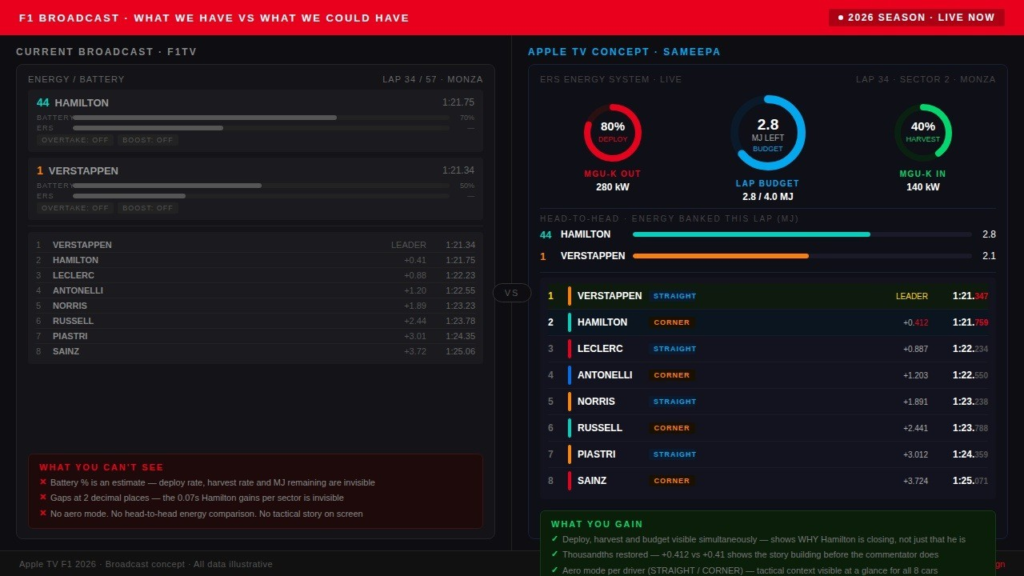
    The left side is what F1 fans see right now. The right side is what Apple’s ecosystem already makes possible. Five fixes. No new tech needed.

    March 16, 2026

    Apple has the best design team in the world and Formula 1 is the most technically complex sport on Earth. But right now, the broadcast is failing the story.

    The growth numbers are undeniable:

    • 135% U.S. growth: ESPN handed Apple the keys after growing the U.S. audience from 554,000 in 2018 to a record 1.3 million average viewers in 2025.
    • Global scale: 1.83 billion cumulative viewers in 2025, with 76.1 million watching every race weekend—the highest since 2020.
    • Mainstream takeover: 57% of new fans are under 35. This isn’t a niche motorsport audience anymore; it’s a mainstream entertainment powerhouse.

    As former live news anchor and producer, I see the gap. Apple has the ecosystem—Watch, Vision Pro, M-series silicon—to deliver “Computational Racing.” Yet, the 2026 broadcast feels like linear TV.

    Apple called 2026 a “transformative new era” for F1. To fulfill that promise, here are five places where Apple’s design DNA needs to show up before the next green flag.

    F1 races are decided by 0.050 seconds. The broadcast shows gaps to two decimal places. That’s a production choice that actively buries the story.


    1. The energy graphics are failing the story

    The biggest on-track change of 2026 is invisible on screen.

    The new power units deploy up to 350kW from the MGU-K (Motor Generator Unit — Kinetic, the electrical motor that drives the rear wheels) alone. That’s nearly triple the previous spec. Right now the broadcast shows this as a simple battery bar — it is an estimate. From Race 2 we also got indicators for “Overtake” and “Boost” mode being active. But none of this explains why one car is faster on a straight without having pressed any button. That’s because of something called superclipping.

    Superclipping is when the MGU-K harvests electrical energy while the driver is still at full throttle at the end of a straight — the car is essentially recharging and slowing slightly at the same time, which looks counterintuitive to a new fan. (Talking of new fans Sarah Kaye has an easy-to-understand visual explainer on superclipping.) Madeline Coleman at The Atlantic explains why these new modes will require TV graphics to carry the storytelling weight for home viewers.

    Superclipping is the tactical battle of every lap. Viewers can’t see it happening.

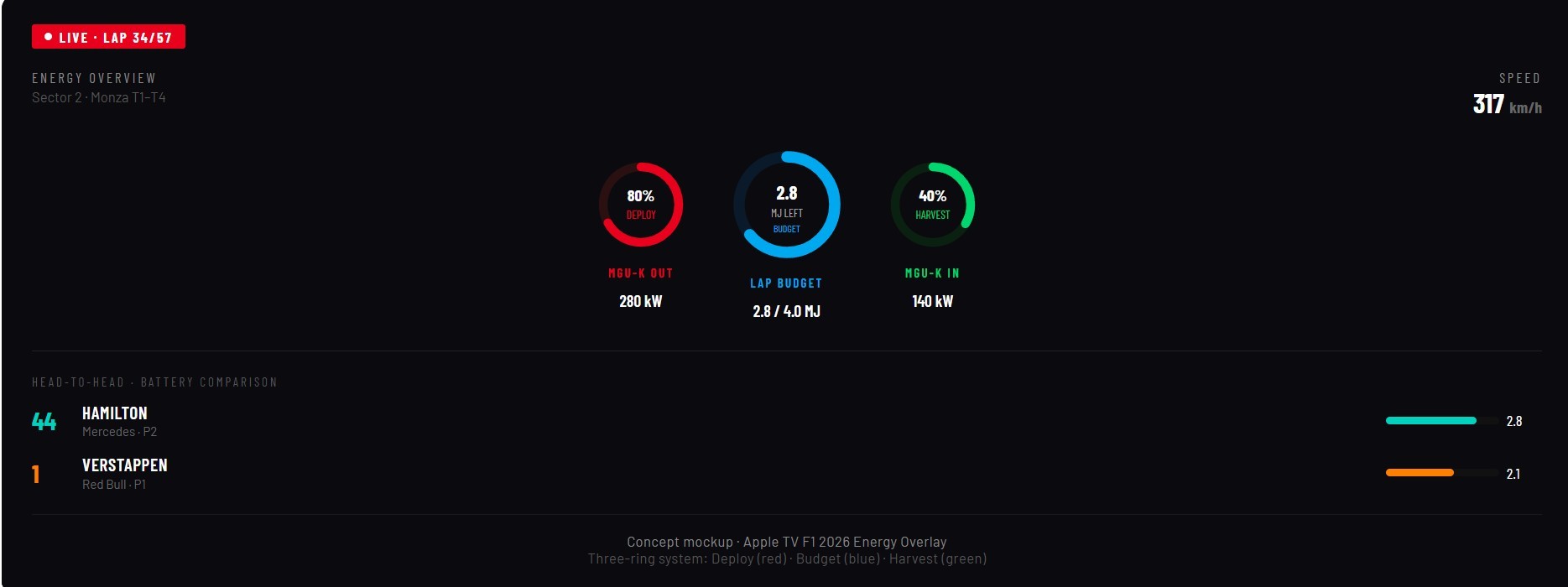
    So, how can we fix this and make this tension visible on screen? Well, the answers are already in Apple’s design language – the Apple Watch Activity Ring! It works because the brain reads a ring’s completion state faster and more instinctively than a bar — this is the Gestalt principle of closure in action. Apply it here: three rings to show the three dynamics at play simultaneously – a Deploy ring (instantaneous MGU-K output), a Harvest ring (energy recovered under braking), a Budget ring (megajoules remaining this lap).

    Here’s a mockup I built using Anthropic‘s #Claude!

    ERS Energy Ring
Alt text: Concept mockup of an Apple TV F1 2026 ERS Energy Ring graphic overlay. Three circular rings in red, blue and green show real-time MGU-K deployment, lap energy budget, and harvest rate for Hamilton and Verstappen side by side.
Caption: Three rings replace the current battery bar. Red = MGU-K deployment (280kW live), Blue = lap energy budget (2.8 of 4.0 MJ remaining), Green = harvest rate. The head-to-head shows Hamilton with 0.7 MJ more banked than Verstappen entering Sector 3 — the actual reason the gap is closing.

    Put two drivers side by side in that view and you can see why one car is closing — not because of the draft, but because it has harvested 22% more energy over the last two sectors. That’s the actual tactical story of 2026. Right now, viewers can’t see it.

    The energy story is the biggest miss. But it’s not the only one.


    2. The thousandths of a second need to come back

    F1 races are decided by 0.050 seconds. The broadcast currently shows timing gaps to two decimal places.

    The fan community noticed. The r/F1TV thread “We demand thousandths of seconds back on the timings graphic” has thousands of upvotes and is still going.

    Ian Holmes and Dean Locke three decimal places isn’t just for purists—it’s the hallmark of F1 that creates tension on every lap. At two decimal places, a gap looks static. At three, you watch it closely in real time. That’s tension. That’s why people stay on the couch.

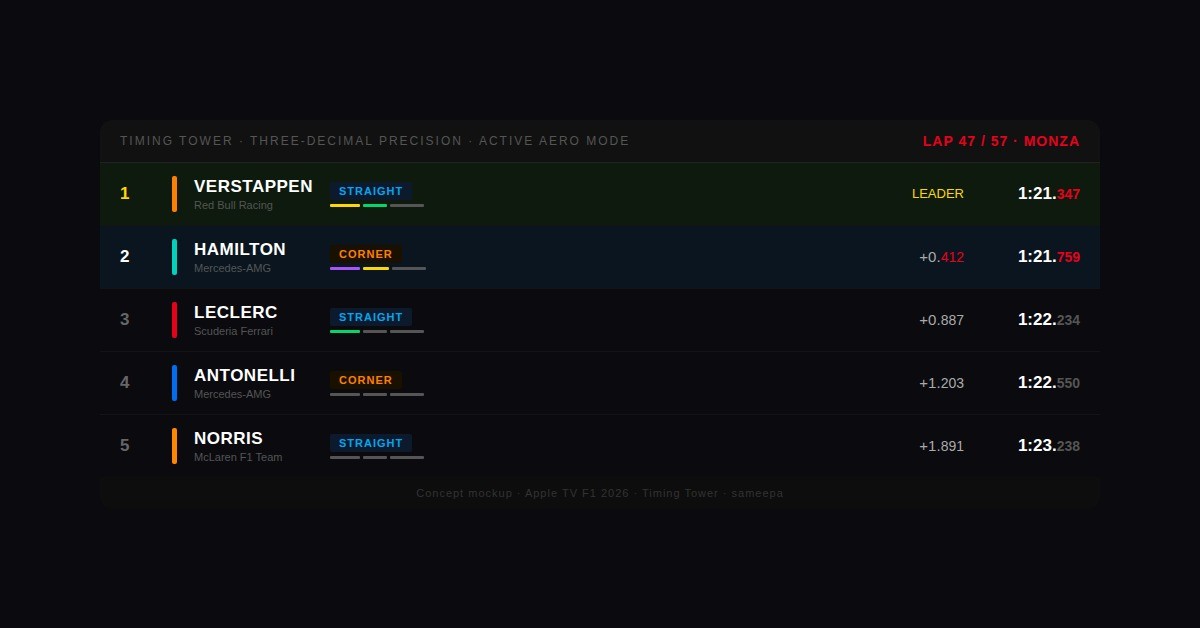
    Stack the active aero mode alongside each driver — a small pill showing whether they’re in “Straight Mode” (low drag, fast on straights) or “Corner Mode” (high downforce, better through turns) — and the timing tower becomes a tactical map.

    Concept mockup of an Apple TV F1 2026 timing tower. Five drivers shown with three-decimal-place gaps, team color stripe, active aero mode pill (STRAIGHT or CORNER), and sector-best color bars. Verstappen leads with Hamilton 0.412 seconds behind.
Caption: Thousandths restored. Active aero mode per driver. Color-coded sector bests. At three decimal places the 0.412s gap between Hamilton and Verstappen shows the story building — at two, it looks static.

    Precision and context cost nothing to add. The next one costs slightly more imagination — but the industry has already done the hard work.


    3. New fans are losing the thread in real time — and there’s a whole industry built to fix it

    This season’s broadcast has been using terms like “superclipping,” “torque fill” (the brief lag as the combustion engine fills the power gap when the MGU-K switches modes), and “active aero modes” and not always explaining them. For the fan who came in through Drive to Survive, this is the moment they stop following and start scrolling.

    This isn’t a commentary problem. It’s an interaction design problem — and other sports have already solved it.

    Ease Live places interactive graphic overlays on a live stream without touching or interrupting the main feed. They just deployed on Red Bull TV for Premier Padel — a sport with a similarly new global audience: viewership grew 30% year-on-year, with their overlays delivering a 50% increase in viewer duration, 68% poll response rates, and a 56% improvement in overall viewer engagement across global sports deployments. The feature that did the work for new fans? “Playbook” videos — short, tappable educational clips embedded in the stream explaining rules and tactics without pausing the action.

    The F1 version is straightforward to imagine Royce C. Dickerson: a viewer hears “superclipping,” an icon appears at the edge of the screen. Tap it — a 15-second animation shows the MGU-K switching into harvest mode at full throttle on the back straight at Monza.

    LiveLike ran the same approach for NASCAR, starting from the 2021 Daytona 500: in-app polls, predictions, a cheer meter, and alerts layered over the live race. In the first year, NASCAR‘s engagement with interactive features grew 22% over the season, with total impressions growing 140% — reaching nearly one million in October 2021 alone. LiveLike now works with Canal+, La Liga, Sky Sports Premier League, and the NBA.

    The tools to retain new fans exist and are proven at scale. Now they just need to be adopted!


    4. The AI opportunity is being left on the table

    The F1 TV commentary team — led by Laura Winter (Congratulations to her on the birth of her son) alongside Alex Jacques, Jolyon Palmer, Ruth Buscombe (my girl crush!), David Coulthard, Sam Collins, and newcomer Juan Pablo Montoya — are committed to providing “digestible explanations of strategy calls, technical developments, and key regulation changes.” That’s the right intention.

    But no human under live broadcast pressure can hold 75 years of race data and surface the right stat in the right 10-second window. A model trained on F1’s full archive can.

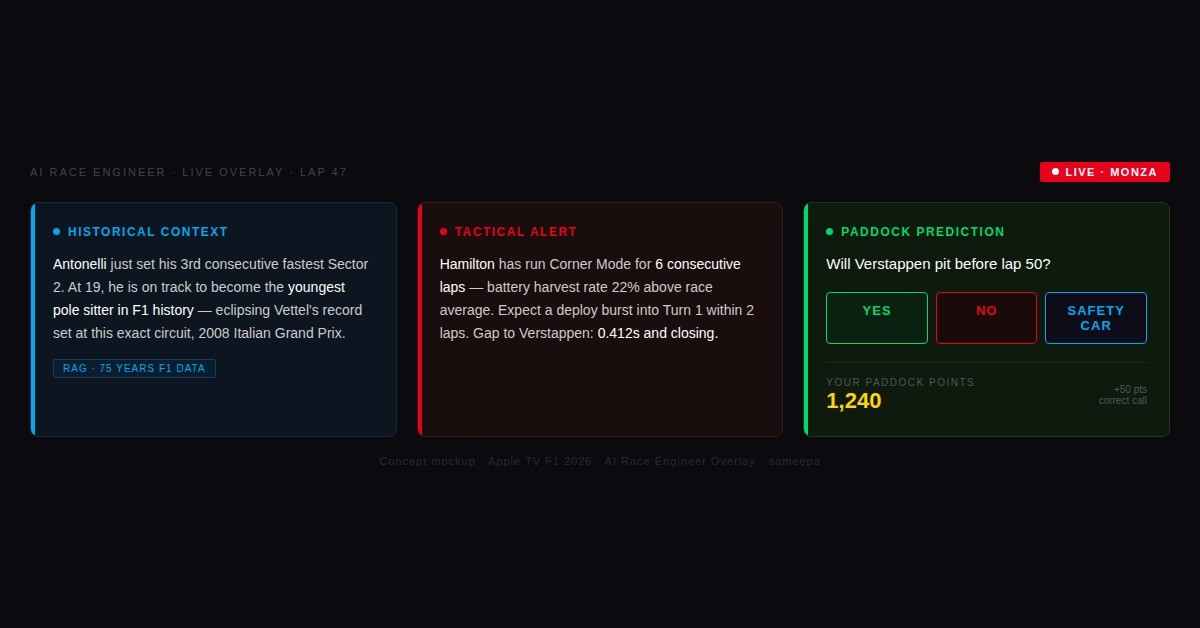
    When Antonelli crosses the line for pole at Monza, it already knows: youngest pole sitter since Vettel, same circuit, 2008 Italian Grand Prix. Computer vision tracking car trajectories can flag tactical patterns two to three laps before they produce an overtake.

    This is about augmenting the booth. (cc Robert Patla ) It’s about giving producers and on-air talent a research assistant that never misses the moment and continues to add context for richer storytelling!

    Concept mockup of an Apple TV F1 2026 AI Race Engineer overlay showing three cards: a blue historical context card placing Antonelli as youngest pole sitter since Vettel in 2008; a red tactical alert on Hamilton's energy harvest pattern; and a green prediction card with live fan voting and Paddock Points.
Caption: Historical context surfaced in real time (blue). Tactical alerts flagged 2–3 laps early (red). Live fan prediction engine with Paddock Points (green). None of this interrupts the main feed.

    Four of these five fixes are about data and design. The last one is about people — how you use the ones already in the paddock.


    5. Celebrities at races are an asset — when used with context

    The current approach: cut to someone famous in the paddock, no information, then cut back to the race. That’s dead air dressed up as glamour.

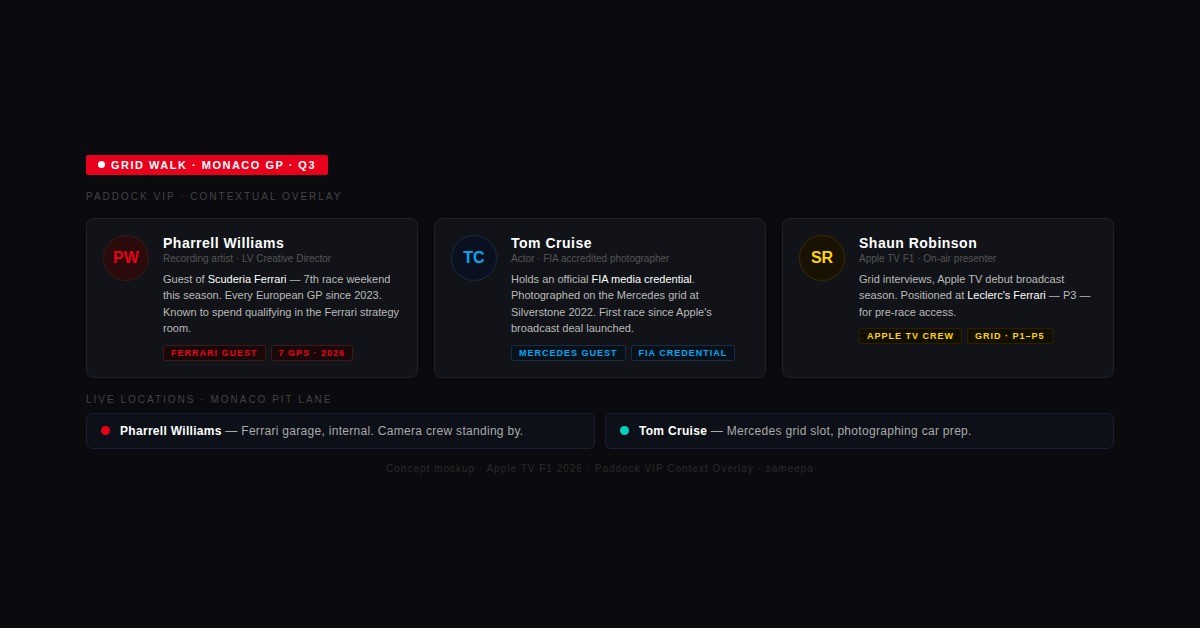
    The better approach costs nothing extra. Pharrell Williams in the Ferrari garage — a brief lower-third: his seventh race weekend this season, always positioned inside the strategy room during qualifying. Tom Cruise on the grid at Silverstone — he holds an actual FIA (Fédération Internationale de l’Automobile) media credential. These are genuine cultural crossover moments for fans who came to F1 through music or film.

    Context turns a cutaway into a story beat. Without it, they’re a cutaway that cost you 20 seconds of racing.

    Concept mockup of an Apple TV F1 2026 AI Race Engineer overlay showing three cards: a blue historical context card placing Antonelli as youngest pole sitter since Vettel in 2008; a red tactical alert on Hamilton's energy harvest pattern; and a green prediction card with live fan voting and Paddock Points.
Caption: Historical context surfaced in real time (blue). Tactical alerts flagged 2–3 laps early (red). Live fan prediction engine with Paddock Points (green). None of this interrupts the main feed.

    The number that puts this in perspective

    Apple is paying $150M per year for these rights. Eddy Cue said at the partnership launch: “2026 marks a transformative new era for Formula 1… we look forward to delivering premium and innovative fan-first coverage in a way that only Apple can.”

    F1 now counts 827 million global fans — 57% of new fans in 2025 were under 35, and 48% were female. That is not a niche motorsport audience. That is a mainstream entertainment audience that arrived recently and is still deciding whether to stay.

    The 2026 power unit regulations produce more tactical complexity per lap than most sports produce per game.

    The tools to show it — rings, spatial computing, AI inference, interactive overlays — already exist inside Apple’s ecosystem. This is the rare case where the hardest part isn’t building anything new. It’s just pointing what already exists at the right problem.


    #F1 #AppleTV #Formula1 #SportsBroadcasting #SportsMedia #MediaProduction #F1TV #BroadcastInnovation

    This was first published on LinkedIn.

  • The rapid feedback loop of Formula One

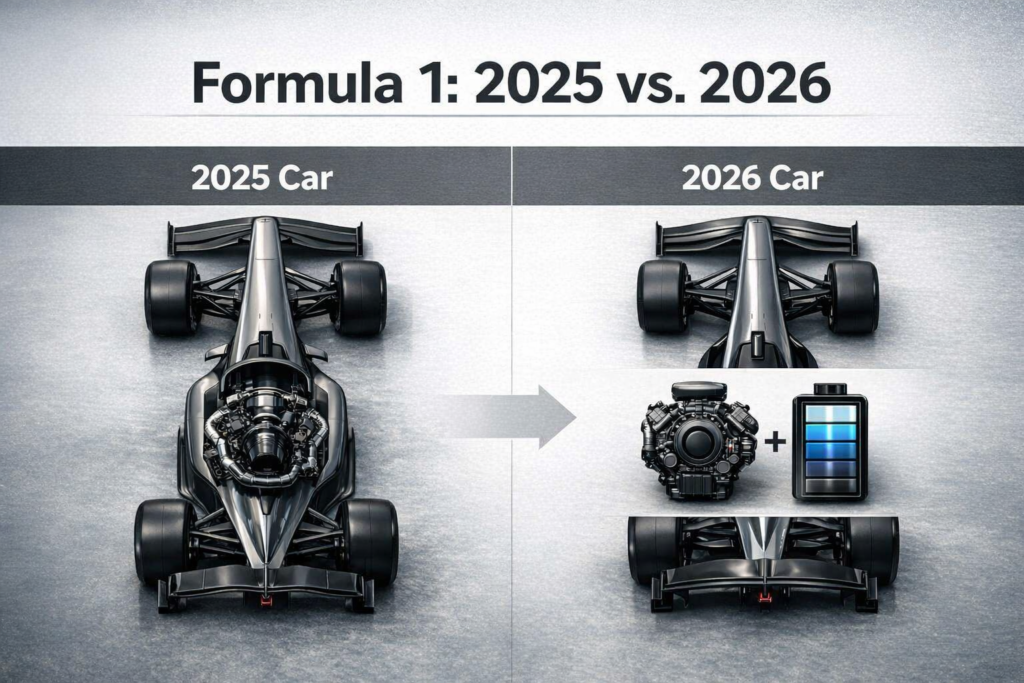
    In the high-stakes world of Formula One, a fundamental shift is unfolding. As we approach the Miami Grand Prix, the sport is evolving beyond the roar of the engine and a star driver’s reflexes. It’s now as much about energy management, simulations, and algorithms as it is about the racing line and reaction times.

    The Tension: Road vs. Race

    Formula 1 is currently walking a tightrope. On one side are the car manufacturers (OEMs) like Audi and Ford. They want “road relevance.” They need the technology in the car to eventually help sell a hybrid SUV in a showroom. This is why the MGU-H—a brilliant but incredibly expensive piece of tech that recovered heat from the exhaust—was banned.

    On the other side are the purists. They want the light, loud, fire-breathing dragons of the past. By ditching the MGU-H and focusing on a 50/50 power split between the engine and a massive electric motor (the MGU-K), F1 has traded some “pure” racing soul for a more sustainable, manufacturer-friendly future.

    The Regulation Tweak: 3 Key Fixes

    Three races in, the data told a story: the cars were fast, but the “energy gaps” were dangerous. Here is how Formula 1, the FIA and OEMs are iterating in real-time:

    1. The “Super Clip” (Fast Charging)

    • The Problem: To fill their batteries, cars were “clipping”—slowing down significantly at the end of straightaways even while the driver was at full throttle. It looked like the car hit an invisible wall.
    • The Fix: The charging limit was boosted from 250kW to 350kW.
    • The Result: The battery fills faster, meaning that “slow” period is much shorter. It’s the difference between a slow phone charger and a “Super-Fast” one. You get back to full speed sooner.

    2. The Qualifying Squeeze

    • The Problem: In qualifying, drivers were spending the whole lap managing their “energy budget” instead of just driving flat-out.
    • The Fix: The energy limit was cut from 8 Megajoules to 7 Megajoules.
    • The Result: By lowering the ceiling, drivers don’t have to spend as much time “harvesting.” It forces them to be more efficient and allows for more “natural” flat-out laps.

    3. The Boost Mode

    • The Problem: Massive speed differences between a car using “Boost” and a car “Harvesting” led to scary close calls (like Ollie Bearman’s incident).
    • The Fix: “Boost” is now capped at +150kW above what they’re already running. In twisty sections of the track, power is further limited to 250kW.
    • The Result: We are smoothing out the spikes. No more “Mario Kart” jumps in speed that catch other drivers off guard.

    The Fan Verdict (Reddit Sentiment)

    The r/formula1 community is a mix of fascination and frustration.

    • The “Formula E+” Tag: Many fans worry the sport is becoming “Formula E on steroids,” where the battery matters more than the driver’s right foot.
    • The “Chef” Comment: Fans loved Fernando Alonso’s joke that the cars are so automated and “slow” in corners that you could put a “chef in the cockpit.”
    • The Consensus: While purists miss the V10 scream, most agree that the 350kW super-clipping is a “no-brainer” to stop the awkward mid-straight slowing.

    What to Watch for in Miami

    Keep your eyes on the McLaren MCL40. Team Principal Andrea Stella is bringing a massive update to Florida. They are currently chasing Mercedes (89 points ahead), and this “new car” is their attempt to prove they have mastered the energy-management puzzle better than the rest.

    The connection between racing and software development lies in this iterative feedback loop: Hypothesize, Prototype, Build, Race, Measure, Iterate. (Any product managers feeling the vibe?) Miami marks the beginning of a data-driven race series, where engineers and drivers will meticulously gather insights, and teams will strive for the smallest advantage. That’s what makes racing so captivating!


    First published on LinkedIn on April 25th, 2026

    #F1 #MiamiGP #Engineering #Formula1 #Innovation #HybridFuture

  • Anthropic Just Did What OpenAI and Google Haven’t. And It’s More Significant Than the Headline Suggests.

    Anthropic Just Did What OpenAI and Google Haven’t. And It’s More Significant Than the Headline Suggests.

    Earlier this month, Anthropic quietly made one of the most consequential go-to-market moves in AI this year. No splashy product launch. No new model announcement.

    Just a $100 million commitment to a structured partner program — the Claude Partner Network — and a clear signal about how they intend to win the enterprise.

    As a partner marketer for a software platform where GSI relationships were crucial, this press release made me sit up. It signaled a company that was building an ecosystem and leaning into its market lead.

    Here is why this matters, and what it tells us about where the enterprise AI race is actually headed.

    The scoreboard: where Anthropic actually stands

    Before we talk about the partner program, we need to talk about the scoreboard — because the shift has been dramatic.

    According to Menlo Ventures2025 State of Generative AI in the Enterprise report, the era of automatic OpenAI wins is over. Look at the shift in enterprise LLM API market share over the last two years:

    • Anthropic: Climbed from 12% to 40%
    • OpenAI: Dropped from 50% to 27%
    • Google: Climbed steadily to 21%

    Enterprise AI investment tripled in a single year — from $11.5 billion to $37 billion in 2025. This isn’t a pilot market anymore. This is full-scale production. And in a production environment, Anthropic is leading.

    The $100M partner program is Anthropic saying: We’re winning the product game. Now we are building the commercial infrastructure to make that lead permanent.

    What Anthropic actually announced

    The Claude Partner Network isn’t just a badge you put on a website. It’s operational infrastructure. The $100M funds:

    1. Direct capital: Subsidizing partner training, sales enablement, and co-marketing.
    2. Technical scaling: A fivefold expansion of Anthropic’s partner-facing team, bringing dedicated Applied AI engineers and architects into live customer deals.
    3. Formal credentials: Launching the Claude Certified Architect certification, with developer and seller tracks following close behind.
    4. Targeted IP: A “Code Modernization” starter kit designed specifically for legacy codebase migration.

    Anchor partners: Accenture, Deloitte, Cognizant, and Infosys. Membership is free.

    “We’re training 30,000 Accenture professionals on Claude because that’s what it takes to meet the demand we’re seeing.” Alex Holt , Vice Chair, Global Head Anthropic Business Group, Accenture

    You don’t pull 30,000 billable practitioners offline for training unless client demand is already pulling you forward. Cognizant went further — opening #Claude access to its entire workforce of roughly 350,000 associates. That’s an operational decision, not a press release commitment.

    The contrast: OpenAI vs. Google vs. Anthropic

    OpenAI‘s securing its enterprise footprint largely through bilateral deals. Their collaboration with Accenture on #ChatGPT Enterprise is real — but it’s a localized partnership, not a funded ecosystem program with certification infrastructure, shared playbooks, and a public directory. With usage share dropping from 50% to 27%, their recent executive hires signal they’re playing catch-up on GTM infrastructure.

    Google leaned on its existing Google Cloud Partner Network when launching Gemini Enterprise, with Accenture, Deloitte, and TCS already involved. GCP gives them natural distribution. But they haven’t made a single, concentrated, net-new dollar commitment to building an AI-specific enablement layer the way Anthropic just did.

    OpenAI has bilateral deals. Google has platform reach. Anthropic now has a structured ecosystem program with hard dollars behind it. That is a meaningful distinction.

    The code modernization play — and why it’s brilliant

    Buried in the launch is a Code Modernization starter kit. Anthropic calls this “one of the highest-demand enterprise workloads.” They’re right — but this isn’t just a product decision. It’s a deliberate wedge aimed at the most lucrative and most painful part of the GSI client portfolio.

    Banks, insurers, and government agencies hold the most legacy COBOL in the world — and they’re the core client base for every #GSI on Anthropic’s partner list. Accenture reported $2.2 billion in advanced AI bookings in Q1 FY2026 alone, nearly double the prior year, with financial services among the primary sectors driving it. Legacy modernization is the defining transformation challenge for these clients right now.

    A thoughtful IBM executive recently pushed back on this framing: if AI writes all the code anyway, why does the underlying language matter? COBOL skills aren’t the bottleneck if agents handle the coding. Mainframe migration is full system re-engineering, not just code translation. Fair point. Parts of it are correct.

    But here’s the question that argument can’t fully answer:

    Do you actually know which category your 40 million lines of COBOL fall into?

    An acquaintance who spent his entire career working with COBOL for financial services since the ’70s put it this way: enterprises really run three kinds of code. First, the mission‑critical transaction systems you simply don’t touch, and for good reason. Then there’s the business logic written in COBOL because, well, it was 1987 and that’s what everyone used — all tightly coupled by accident. And finally, the integration and reporting layers that’s still on the mainframe mostly because it’s always been there, not because it makes architectural sense today.

    And most enterprises can’t tell you which is which. That diagnostic is itself a high-value engagement. Anthropic’s starter kit gives a Deloitte or Infosys seller a structured entry point for a conversation that can grow into a multi-year, tens-of-millions-of-dollars modernization program. This isn’t about picking a fight with IBM. It’s about handing partners a wedge into the most stubborn — and most valuable — transformation problem in enterprise technology.

    The $100M question: MDF, PDF, or SDF?

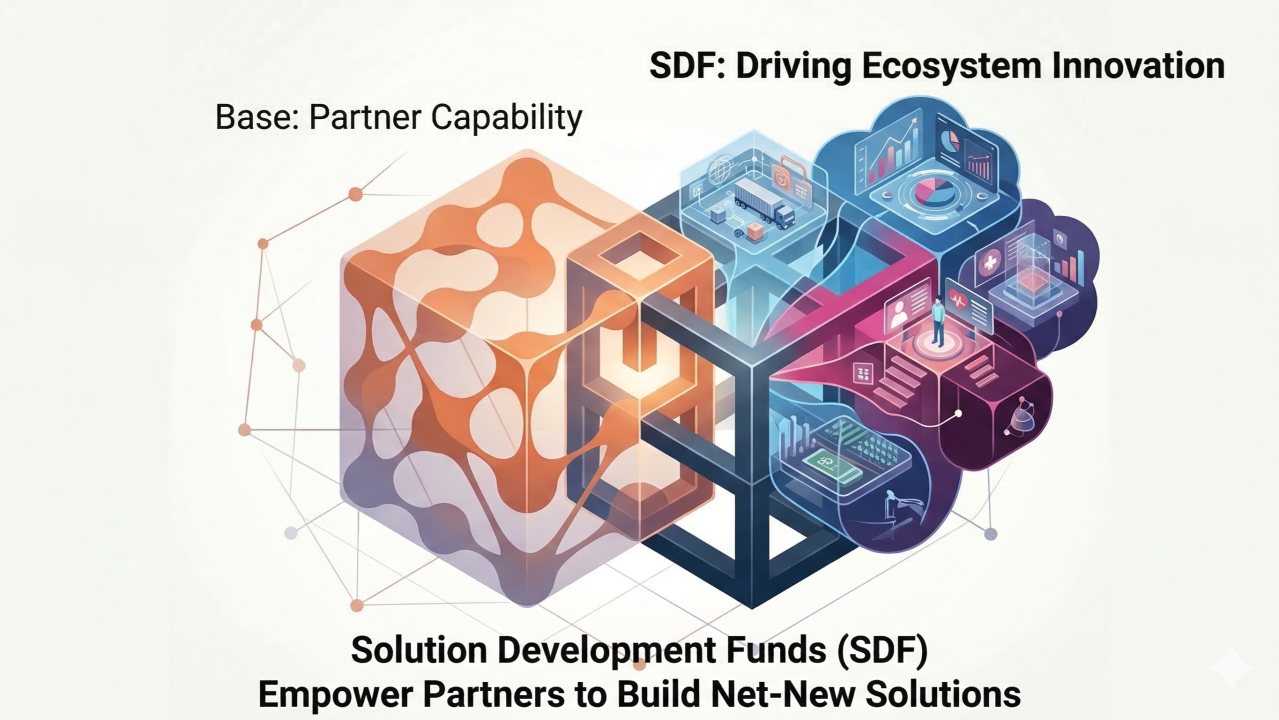
    As a partner marketing professional, the part I’m intrigued by is how Anthropic will deploy this capital. Is this a traditional Market Development Fund (MDF), a Partner Development Fund (PDF), or a Solution Development Fund (SDF)?

    The answer dictates what success looks like in 18 months.

    • MDF optimizes for immediate pipeline (webinars, lead gen).
    • PDF optimizes for partner capability (certifications, trained headcount).
    • SDF optimizes for ecosystem innovation (partners building net-new industry solutions on your platform).

    Given that Anthropic included shared sales playbooks, embedded engineering support, and specific IP starter kits, this looks like an SDF. It’s designed to accelerate deep capability-building, not just top-of-funnel marketing.

    If that’s right, the benchmark for success isn’t how many co-branded events happen this quarter. It’s how many Claude-native solutions get built by GSI practices for highly regulated industries that Anthropic’s direct sales team could never penetrate on their own.

    That’s the real bet. And looking at the scoreboard, it’s exactly the right one.


    Next up: From MDF to SDF — how tech companies build partner ecosystems, why some fail, and what the Salesforce and AWS playbooks tell us about what Anthropic is actually trying to do here. It’s a rabbit hole I went down early in my partner marketing career, and right now it feels more relevant than ever. Worth a read if you’re trying to understand where sales, marketing, and alliances are heading.

    Originally published on LinkedIn March 18th, 2026. Republished here with updates.